
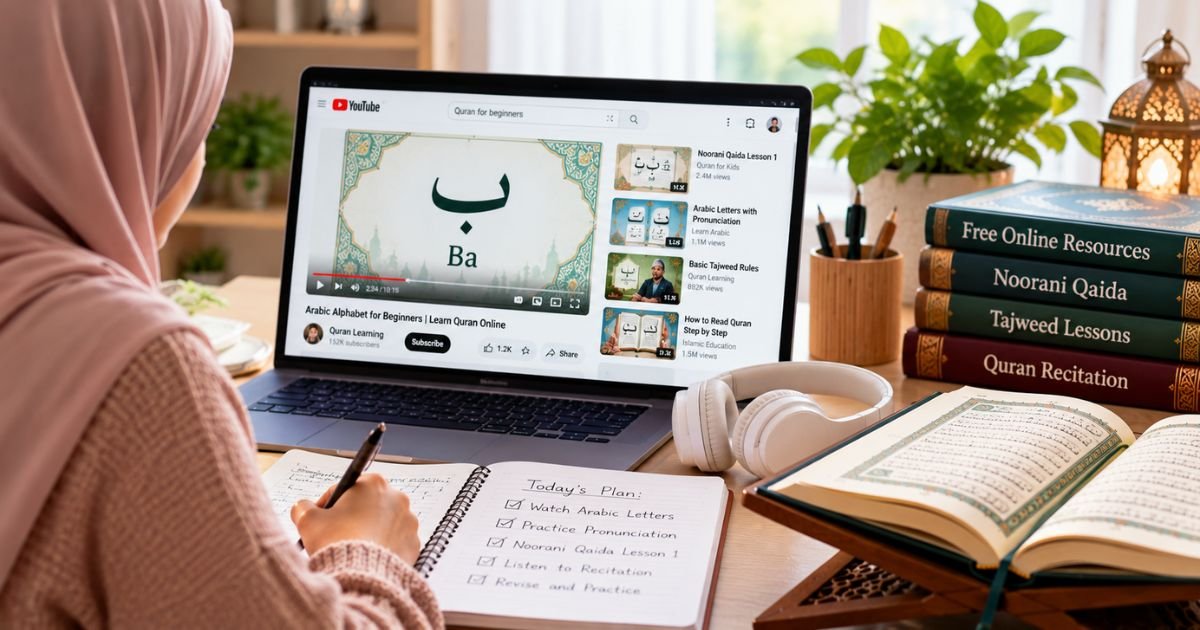
If you want to learn the Quran but are not ready to pay for online classes, you can start with free learning resources. From Arabic letter lessons to Quran recitations and beginner reading exercises, there are several ways to begin learning from home.
However, choosing the right resources is important. Beginners need to understand Arabic letters, practise pronunciation and gradually develop their reading skills. Simply watching videos or listening to recitations may not be enough to identify and correct mistakes.
In this guide, you will learn how to learn the Quran online for free, which resources to explore, how to create a simple study routine and when working with a Quran teacher may be helpful.
Can You Learn the Quran Online for Free?
Yes. Free online resources can help you start learning Arabic letters, understand basic Quran reading concepts, listen to recitations and revise what you have studied.
Your progress will depend on your current level, the quality of the resources you use and how consistently you practise.
If you are a complete beginner, start with the Arabic alphabet and basic reading rules. If you already know how to read Arabic, you may be able to focus on improving your fluency and learning introductory Tajweed rules.
One important point to remember is that free learning resources and free live classes are not the same thing. Some websites provide free lessons or educational material, while live teaching and individual feedback may require payment.
1. Start by Learning the Arabic Alphabet
If you cannot recognise Arabic letters, begin here.
Learning the Arabic alphabet gives you the foundation needed to read Quranic text. Take time to recognise each letter and practise its sound before moving on to more complex lessons.
Focus on:
- Recognising the Arabic letters.
- Learning the sound associated with each letter.
- Distinguishing between similar-looking letters.
- Understanding how letters connect within words.
- Practising the letters regularly until you recognise them confidently.
You can use free educational videos and printable Arabic alphabet charts to support your practice.
Try not to learn every letter in a single session. Study a small group, revise it and then move on to the next group.
2. Use Free Noorani Qaida Learning Resources
Noorani Qaida is commonly used to help beginners develop foundational Arabic reading skills.
You can look for free Noorani Qaida lessons, reading demonstrations and practice materials online. These resources can introduce you to letter recognition, vowel signs and the process of reading connected letters.
When studying independently, follow a structured sequence rather than jumping between unrelated videos.
For example:
- Learn the Arabic letters.
- Practise Fathah, Kasrah and Dammah.
- Study Sukoon and Shaddah.
- Practise connected letters and short combinations.
- Gradually move towards reading words and Quranic text.
If you are unsure whether you are pronouncing a letter correctly, make a note of it and ask a qualified teacher when possible.
3. Listen to Quran Recitations
Listening to Quran recitation can help you become more familiar with the sound and rhythm of Quranic Arabic.
You can find Quran recitations and recordings through established Quran websites and video platforms. Some provide recitations alongside the Arabic text, making it easier to follow while listening.
To make listening more useful:
- Choose a short passage.
- Follow the Arabic text as you listen.
- Replay a section that you find difficult.
- Listen to the same passage more than once.
- Practise reading it yourself at your current level.
Listening is a helpful supplement to learning, but it does not replace learning the letters and reading rules. If you are a beginner, work through the reading foundations alongside listening practice.
4. Learn Basic Tajweed Gradually
Tajweed refers to the rules and principles used for correct Quranic recitation.
You can explore free introductory Tajweed lessons online. Begin with simple explanations and examples rather than trying to memorise every rule immediately.
Some topics you may encounter include:
- Makharij: The articulation points of Arabic letters.
- Ghunnah: A nasal sound used in specific recitation rules.
- Madd: Rules relating to lengthening sounds.
- Qalqalah: A particular echoing quality associated with specific letters under certain conditions.
- Noon Sakinah and Tanween: Rules governing their pronunciation in different contexts.
These rules have specific applications, so use reliable learning materials and practise with examples. A qualified teacher can help you understand how the rules apply when reciting.
If you are still learning the alphabet, concentrate on your basic reading skills first.
5. Where Can You Find Free Quran Learning Resources?
Several types of online resources can support your learning without an initial course fee.
Quran.com
Quran.com provides access to the Quran text and recitations, along with additional study features. It can be useful for following Arabic text while listening to recitation.
Website: https://quran.com/
YouTube Educational Lessons
YouTube contains free lessons covering Arabic letters, Noorani Qaida, Quran reading and introductory Tajweed.
Choose educational channels that explain concepts clearly and demonstrate pronunciation. Follow a structured beginner series instead of watching random videos without a learning plan.
Website: https://www.youtube.com/
Online Arabic Reading Materials
Free educational websites and downloadable worksheets can help you practise the alphabet, vowel signs and connected letters.
Check that the materials are accurate and suitable for your current level. For religious learning, prioritise reputable educational sources.
Quran Audio Resources
Listening resources can help you follow recitations and repeat short passages during your practice sessions.
Use audio alongside reading practice rather than relying on listening alone if your goal is to learn to read the Quran independently.
Remember: These resources can support self-study, but their features and availability may change. Check each website directly to confirm what is currently available for free.
6. Create a Simple Daily Quran Learning Routine
You do not need to study for several hours every day to get started. A short, consistent routine can make it easier to practise what you learn.
Here is an example of a 20-minute beginner routine:
| Activity | Time |
|---|---|
| Revise Arabic letters or previous lessons | 5 minutes |
| Study a new reading concept | 5 minutes |
| Practise reading aloud | 5 minutes |
| Listen to a short recitation and follow the text | 5 minutes |
Adjust this routine according to your learning level. If you are struggling with a concept, spend more time revising it before introducing something new.
You can also keep a simple learning notebook. Record the letters, rules or words you find difficult so you know what to practise next.
7. Common Mistakes to Avoid When Learning Quran Online for Free
Free resources can be useful, but studying without a clear plan can make progress more difficult.
Using Too Many Resources at Once
Switching between several teachers and learning methods can cause confusion. Choose one structured beginner course or resource and follow it consistently.
Ignoring Pronunciation
Recognising a letter is not the same as pronouncing it correctly. Pay attention to the sounds and articulation points demonstrated in your lessons.
Moving Ahead Too Quickly
Do not rush into advanced recitation rules before understanding the basics. A strong foundation makes later learning easier.
Only Listening Without Practising
Listening can improve familiarity with recitation, but beginners also need to practise reading Arabic text.
Never Getting Feedback
Self-study can help you learn foundational concepts, but you may not notice your own pronunciation mistakes. Whenever possible, ask a knowledgeable teacher to listen to your recitation and guide you.
8. Is Free Self-Study Enough to Learn the Quran?
That depends on your learning goals and current ability.
Free resources can be a useful starting point for recognising Arabic letters, revising reading rules and becoming familiar with Quranic recitation.
However, beginners who want to develop accurate reading and pronunciation may benefit from individual guidance. A teacher can identify mistakes, explain difficult concepts and suggest what to practise next.
You do not have to choose between self-study and formal lessons immediately. You can start with free resources, understand your learning needs and then decide whether additional guidance would be useful.
9. When Should You Consider Online Quran Classes?
You may want to consider structured online classes if:
- You are unsure whether you are pronouncing Arabic letters correctly.
- You find it difficult to follow a learning sequence independently.
- You want regular feedback on your reading.
- You need a consistent lesson schedule.
- You want to progress towards Quran reading or Tajweed with guidance.
For parents, live classes can also provide a structured learning routine for children who need help developing their reading skills.
Before enrolling, compare the lesson duration, weekly schedule, subjects included and monthly fee. Ask whether the teacher can assess your current level and recommend an appropriate starting point.
10. Online Quran Learning at AL Momin Quran Academy
If you have started learning independently and want more structured guidance, AL Momin Quran Academy offers live, one-to-one online Quran classes with flexible UK-friendly timings.
The academy provides several monthly learning packages:
- Basic Quran Reading — £35 per month: Three days per week, 30 minutes per class, with Quran Reading, Basic Qaida and Daily Duas.
- Standard Quran & Tajweed — £45 per month: Five days per week, 30 minutes per class, with Quran Reading, Tajweed, Pronunciation/Makhraj and Daily Duas.
The academy also offers Premium Quran Learning and Hifz-ul-Quran Intensive packages for students whose learning goals and schedules suit those options.
New students can book a free trial to discuss their current level, learning goals and suitable class timings.
The free trial is an opportunity to explore the academy’s teaching format; it does not mean that ongoing monthly classes are free.
Frequently Asked Questions
How can I learn Quran online for free as a beginner?
Start by learning Arabic letters and their sounds. Use free Noorani Qaida lessons, educational videos and reading exercises. Practise consistently and seek feedback on your pronunciation when possible.
Can I learn Quran online for free without a teacher?
You can begin learning basic concepts independently using free resources. However, a teacher can help correct pronunciation and guide you through reading and recitation rules.
Which website is useful for learning the Quran online?
Quran.com is useful for accessing Quran text and recitations. For Arabic letters and beginner reading lessons, you can also explore structured educational video series and reliable learning materials.
Can I learn Tajweed for free?
You can study introductory Tajweed explanations and examples through free educational resources. For accurate application during recitation, feedback from a qualified teacher can be helpful.
How long does it take to learn to read the Quran?
There is no fixed timeline. Progress depends on your starting level, practice frequency and understanding of Arabic reading rules.
Does AL Momin Quran Academy offer free Quran classes?
AL Momin Quran Academy offers a free trial for new students. Regular monthly packages have fees, starting at £35 per month. Contact the academy for current details and available timings.
Start Learning at Your Own Pace
Learning the Quran online for free can be a practical first step if you want to understand the basics before joining a structured programme.
Begin with Arabic letters, use reliable learning resources, practise regularly and pay attention to pronunciation. As your skills develop, consider whether feedback from a teacher would help you progress with greater confidence.
If you would like individual guidance, explore the courses at AL Momin Quran Academy and book a free trial to discuss your learning goals.