
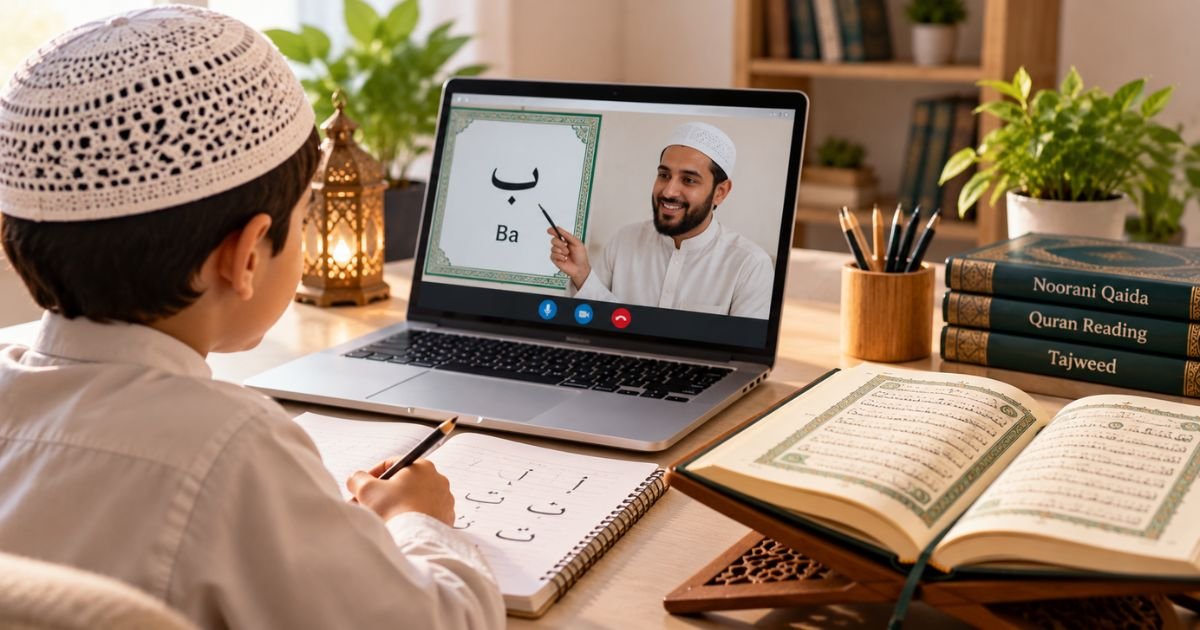
Learning to read the Quran is a meaningful goal, whether you are starting as a child, an adult or someone returning to Quran learning after a long break. If you are a complete beginner, you may wonder where to start, how long it takes to learn and whether online lessons can help you make progress.
The good news is that you do not need to know Arabic before beginning your Quran learning journey. You can start with the Arabic letters, learn how they sound and gradually build the skills needed to read Quranic words.
In this guide, we explain how beginners can learn the Quran online, what to study first and how to develop a consistent learning routine.
Can You Learn the Quran Online as a Complete Beginner?
Yes. Online Quran learning can be suitable for complete beginners who need guidance with Arabic letters, pronunciation and basic reading skills.
Live online classes allow students to learn from home without travelling to a classroom. With one-to-one lessons, the teacher can focus on the student’s current level and provide guidance throughout the learning process.
Beginners should look for a learning plan that starts with the basics rather than assuming they can already read Arabic.
The most important things are to begin at the right level, practise regularly and ask for help when a sound or word is difficult to pronounce.
Step 1: Learn the Arabic Letters
If you cannot yet recognise Arabic letters, this is the best place to begin.
Arabic has 28 letters. Each letter has its own shape and sound, and some letters may initially sound similar to a beginner.
Start by learning to:
- Recognise each Arabic letter.
- Understand the sound associated with each letter.
- Distinguish between letters that look or sound similar.
- Identify how letters appear in different positions within a word.
- Read letters confidently before moving to more complex combinations.
Avoid rushing through the alphabet. Spend enough time recognising the letters and saying their sounds correctly.
Step 2: Start with Noorani Qaida
Noorani Qaida is a commonly used learning resource for beginners who want to develop their Arabic reading skills before progressing to the Quran.
It introduces foundational reading concepts in a structured order. Depending on the teaching method, students gradually practise letter recognition, vowel sounds, joined letters and reading combinations.
During this stage, focus on understanding each lesson instead of memorising it without knowing how to apply it.
A teacher can help identify mistakes early, especially when two letters have similar sounds.
If you are starting from zero, ask your teacher whether Noorani Qaida is an appropriate starting point for your level.
Step 3: Understand the Basic Vowel Signs
After becoming familiar with the letters, beginners need to learn how Arabic vowel signs affect pronunciation.
Three important signs are:
- Fathah: A short vowel sound commonly represented by a small mark above the letter.
- Kasrah: A short vowel sound commonly represented by a small mark below the letter.
- Dammah: A short vowel sound commonly represented by a small mark above the letter.
You will also gradually encounter concepts such as Sukoon, Shaddah and Madd as you progress.
Learn these signs with examples and practise reading aloud under your teacher’s guidance. Correct pronunciation is more important than simply moving quickly through the lessons.
Step 4: Practise Joining Letters and Reading Words
Arabic letters can change shape depending on their position in a word. Beginners therefore need practice recognising letters when they are connected.
Once you understand the individual letters and basic vowel signs, start reading simple combinations.
Your lessons may gradually include:
- Recognising connected letters.
- Reading short combinations of sounds.
- Applying vowel signs to words.
- Identifying longer vowel sounds.
- Reading increasingly complex examples.
Take your time with this stage. Consistent practice helps you recognise familiar patterns more easily.
Step 5: Learn to Read the Quran with Proper Pronunciation
Once you have developed the necessary reading foundations, you can begin applying your skills to Quranic text.
Correct pronunciation matters because Arabic letters can have distinct sounds that affect how words are read.
A qualified teacher can guide you in recognising the correct articulation points, improving difficult sounds and developing your reading accuracy.
As you progress, you can also begin learning Tajweed rules at an appropriate level.
If you are completely new to Arabic reading, it is generally helpful to build your foundational skills first rather than trying to learn every Tajweed rule at once.
Step 6: Build a Simple Daily Practice Routine
You do not need to spend hours studying every day to develop a useful routine. Consistent practice can help reinforce what you learn during your lessons.
Here is an example of a beginner’s practice routine:
| Activity | Suggested time |
|---|---|
| Review previously learned letters or rules | 5 minutes |
| Practise the current lesson | 10 minutes |
| Read examples aloud | 5 minutes |
| Total | 20 minutes |
Adjust the routine according to your teacher’s recommendations, age and learning level.
If you find a lesson difficult, repeat it rather than moving forward before you understand it.
How Long Does It Take to Learn to Read the Quran?
There is no fixed timeline for every student.
Progress depends on your starting level, practice routine, lesson frequency, pronunciation challenges and the amount of guidance you receive.
Someone who already recognises Arabic letters may progress differently from a learner who is starting from the beginning.
Instead of comparing yourself with other students, focus on measurable improvements, such as recognising letters more confidently, reading vowel combinations correctly and making fewer pronunciation mistakes.
Ask your teacher to review your progress regularly and recommend the next steps.
Is Online Quran Learning Suitable for Adults?
Yes. Adults can begin learning the Quran even if they have never studied Arabic before.
Some adults prefer online lessons because they can learn from home and arrange classes around work or family responsibilities.
If you are an adult beginner:
- Be honest about your current reading level.
- Choose lessons that start with the basics.
- Practise regularly between classes.
- Ask questions whenever a pronunciation rule is unclear.
- Set realistic goals and track your progress.
There is no need to feel embarrassed about starting late. Every learner begins somewhere, and a structured approach can make the process easier to manage.
How to Choose Online Quran Classes for Beginners
Before joining an online Quran academy, consider whether the programme suits your current level and learning goals.
Look for:
A suitable starting level: Beginners should be able to start with Arabic letters and foundational reading skills if needed.
Live teacher guidance: A teacher can listen to your recitation, correct mistakes and explain difficult concepts.
A clear learning structure: Lessons should progress logically instead of introducing advanced material too early.
A manageable schedule: Choose class times that fit your routine so you can attend consistently.
Transparent package details: Check the monthly fee, class duration, number of lessons and subjects included before enrolling.
You can also ask whether a trial lesson is available before committing to a monthly package.
Beginner Quran Learning at AL Momin Quran Academy
AL Momin Quran Academy offers live, one-to-one online Quran classes with flexible UK-friendly timings.
Students can explore the available courses and discuss their current level before selecting a suitable learning plan.
The academy’s monthly packages include:
- Basic Quran Reading — £35/month: Three days per week, 30 minutes per class, with Quran Reading, Basic Qaida and Daily Duas.
- Standard Quran & Tajweed — £45/month: Five days per week, 30 minutes per class, with Quran Reading, Tajweed, Pronunciation/Makhraj and Daily Duas.
The most suitable package depends on your learning needs and the subjects you want to study. Contact the academy to confirm which option is appropriate for your current level.
New students can also book a free trial to discuss their learning goals and available timings.
Frequently Asked Questions
Can I learn the Quran online without knowing Arabic?
Yes. Beginners can start by learning Arabic letters, their sounds and basic reading rules before progressing to Quranic text.
Should I learn Noorani Qaida before reading the Quran?
Noorani Qaida is a useful starting resource for many beginners. Your teacher can help determine whether you should begin with it or start at a different level based on your existing skills.
How much time should a beginner practise each day?
A short, consistent practice session can be helpful. For example, you might start with 15–20 minutes daily and adjust the amount according to your teacher’s advice and your schedule.
Can adults start learning the Quran from zero?
Yes. Adults can begin with Arabic letters and basic reading skills, then gradually progress to Quran reading and Tajweed.
Are online Quran classes available in the UK?
Yes. AL Momin Quran Academy offers live, one-to-one online classes with UK-friendly timings. Contact the academy to discuss availability.
How can I book a beginner Quran lesson?
Visit AL Momin Quran Academy’s website to explore the available courses and book a free trial. You can discuss your current level and preferred schedule before choosing a package.
Start Your Quran Learning Journey
Learning the Quran as a beginner becomes more manageable when you follow a structured plan, practise regularly and receive guidance at the right level.
Begin with the Arabic letters, build your reading foundations and progress towards Quran reading and Tajweed at a pace that suits you.
If you are ready to start, explore the courses offered by AL Momin Quran Academy and book a free trial to discuss your learning goals.